What Part Did Isabella Deste Play in Renaissance Art
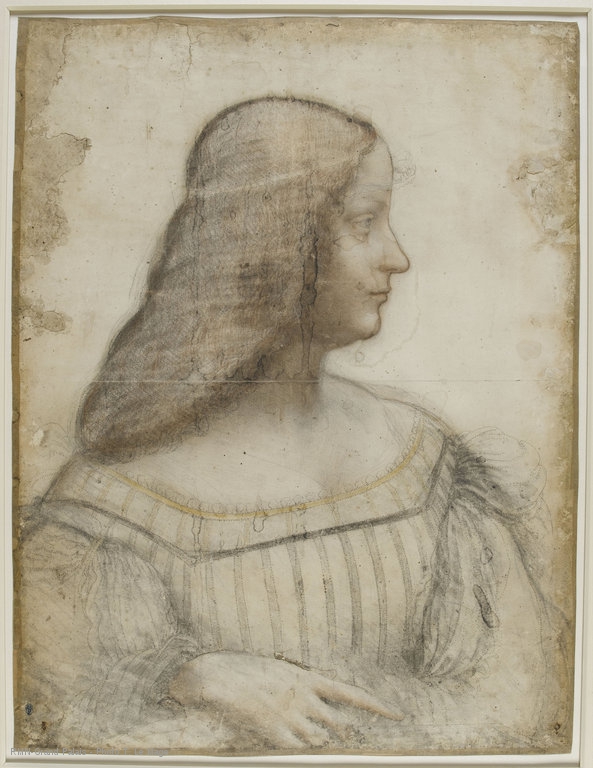
Leonardo da Vinci, Portrait of Isabella d'Este, c. 1499-1500, chalk on paper, 61 x 46.five cm (Musée du Louvre, Paris)
In European history classes, we oftentimes hear about renaissance men: Cosimo de' Medici, Leonardo da Vinci, and Niccolò Machiavelli. Where were the women? The most famous female patron of the Italian renaissance was Isabella d'Este Gonzaga (1474–1539), marchioness of a territory in northern Italy called Mantua. Despite the restrictions women faced, her art collections demonstrate of import renaissance themes: possessing the ancient world through the collection of antiquities, demonstrating erudition through the conquering of classical narratives, and fashioning an identity through portraiture and symbols.
A desire for antiquities
Isabella'due south messages reveal a longing for ancient art objects and sculptures. A bust of the Roman emperor Octavian, an onyx vase, a Venus given by Cesare Borgia (the possible illegitimate son of Pope Alexander VI), and a Cupid attributed to the ancient Greek sculptor Praxiteles were documented in her drove. Isabella displayed the Praxitelean Cupid side by side to a Sleeping Cupid past the renaissance artist Michelangelo in order to compare these ancient and modern sculptures.
When Isabella d'Este could not acquire an aboriginal sculpture, she turned to the sculptor known equally Antico to create statuettes in gold and bronze in an antique mode. One bronze sculpture depicted the Greco-Roman hero Hercules lifting and crushing the behemothic Antaeus in a nude wrestling competition. Cast in 1519, Isabella'due south Hercules and Antaeus is noteworthy for its depiction of musculature. The statuary sculpture was marked with an inscription of buying, D / ISABEL / LA / M E MAR (Divine Isabella, Marchioness of Mantua). Isabella's Hercules and Antaeus measures most 15 inches tall. Scholars have considered how these small sculptures could exist examined closely and demonstrate the interactive nature of early modern art reception.
![Giancristoforo Romano, Portrait medal of Isabella d'Este [obverse], 1507, bronze, .039 cm diameter (National Gallery of Art, Samuel H. Kress Collection)](https://smarthistory.org/wp-content/uploads/2019/08/MedalWorn-870x489.jpg)
Giancristoforo Romano, Portrait medal of Isabella d'Este [obverse], 1507, bronze, .039 cm bore (National Gallery of Art, Samuel H. Kress Drove)
A careful patron of portraits
Surviving portraits of Isabella d'Este and accounts of her commissions bespeak her conscientious control of representations of her physical appearance. The sculptor and medallist Gian Cristoforo Romano bandage bronze medals featuring an idealized Isabella in contour on the obverse and zodiac symbols on the reverse. The profile portrait shows Isabella wearing a substantial necklace framed by a low, angular neckline and her pilus tied back in braids and looped locks surrounded by her name and championship. The reverse features a personification of a figure in sheer drapery and contrapposto stance, who has been interpreted equally Virgo, Astrology, Hygeia, or Victory, with the sign of Sagittarius above surrounded by the inscription BENEMERENTIUM ERGO (variously translated equally "On business relationship of great merit"[i], "Because of merit" [ii], "Considering of the deserving [stars]"[3]). Isabella distributed statuary versions of the medal to those she favored and retained one medal created in gold and embellished with diamonds and enamel .
![Giancristoforo Romano, Portrait medal of Isabella d'Este [obverse], 1495 – 1498, gold with diamonds and enamel, 7 cm diameter (Kunsthistorisches Museum, Vienna)](https://smarthistory.org/wp-content/uploads/2019/08/Medal-870x549.jpg)
Giancristoforo Romano, Portrait medal of Isabella d'Este [obverse], 1495 – 1498, gold with diamonds and enamel, 7 cm bore (Kunsthistorisches Museum, Vienna)
Leonardo da Vinci too drew an idealized version of Isabella d'Este's likeness (meridian of page). While never completed as a painting, Leonardo's drawing of Isabella (c. 1499–1500) provides a detailed depiction of the marchioness with a profile view of her confront and frontal view of her shoulders. Leonardo disguised Isabella's substantial figure in her billowing sleeves. The attention to her garment reveals Isabella'south interest in fashion, which was a frequent subject of her letters. A cartoon later on Leonardo's original reveals that both of Isabella'due south hands may accept been visible and that one manus gestured toward a book, an aspect of erudition, before Leonardo's original drawing was cropped along the lesser edge.
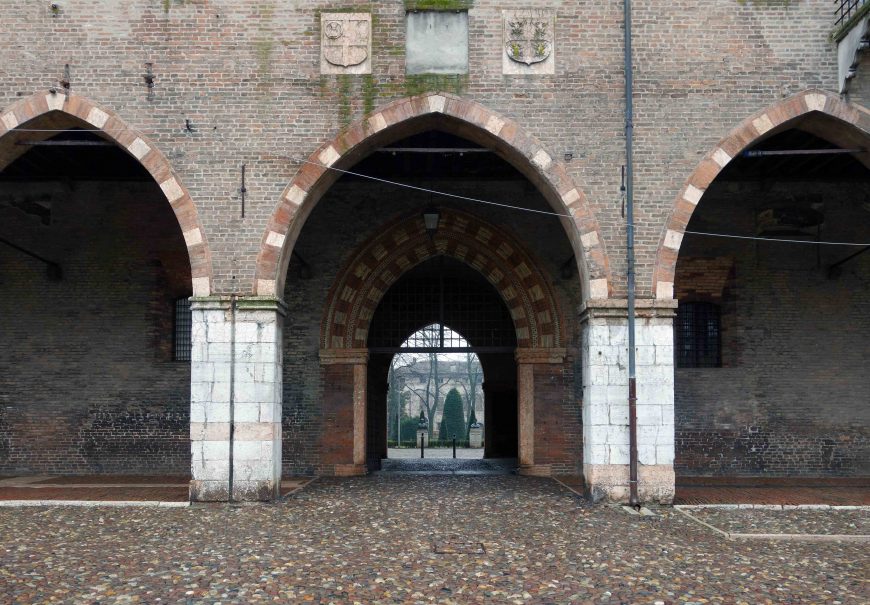
View to the Corte Vecchia, Palazzo Ducale, Mantua, Italy (photo: Steven Zucker, CC BY-NC-SA 4.0)
Spaces for Collecting
Soon after Isabella's spousal relationship to Francesco II Gonzaga, the marchioness adult a space for a painting gallery – her studiolo – and a room to display her growing collections – the grotta . Isabella's original studiolo and grotta were constructed within the Castello di San Giorgio, the medieval castle that forms part of the Ducal Palace in Mantua. Later, these rooms were moved to the Corte Vecchia of the Ducal Palace. The basis-floor location of these later on rooms allowed for the addition of a secret garden and easier access for Isabella, who struggled with mobility as she aged.
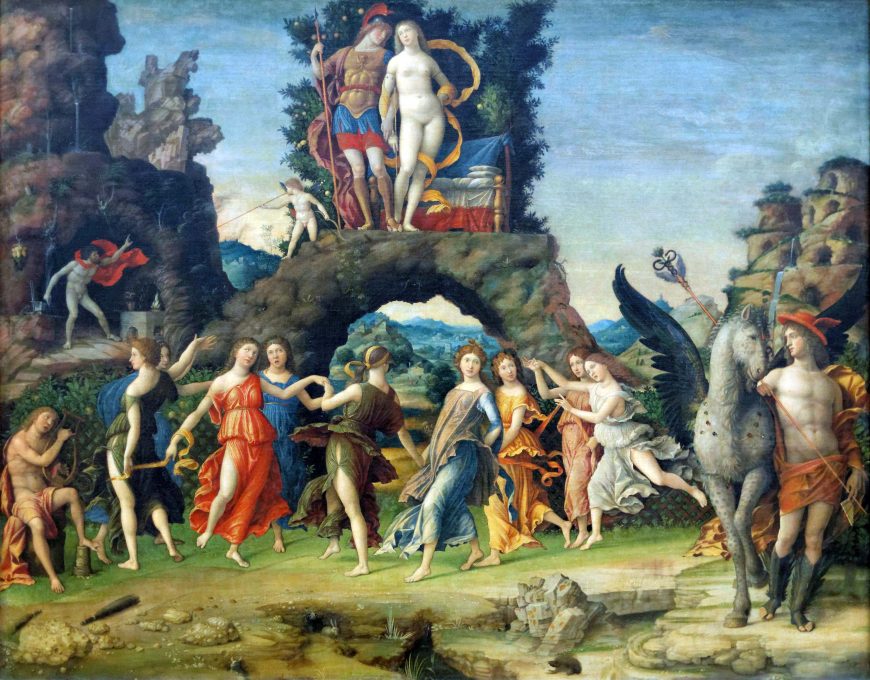
Andrea Mantegna, Mars and Venus (or Parnassus), 1497, tempera and gold on canvas, 159 cm × 192 cm (Musée du Louvre, Paris)
Isabella sought paintings with mythological themes from pregnant renaissance artists for her studiolo . The programme, which scholars continue to debate, was adult in consultation with the humanist scholar Paride da Ceresara. While seven paintings accept been interpreted as allegories of virtue conquering vice, another interpretation emphasizes the paintings' roles within the infinite of the studiolo and within the context of humanist literature at the Mantuan court.[4] The painter Andrea Mantegna delivered the first two paintings Mars and Venus (or Parnassus ) in 1497 and Pallas expelling the Vices in 1502. After much correspondence with Isabella, in 1505, the painter Pietro Perugino delivered the third painting for the studiolo The Combat of Dearest and Chastity (or Battle between Lasciviousness and Chastity ) featuring Pallas and Diana fighting Venus and Cupid. Perugino's painting did non please Isabella; she wrote that it appeared deficient in comparing to Mantegna's canvases.
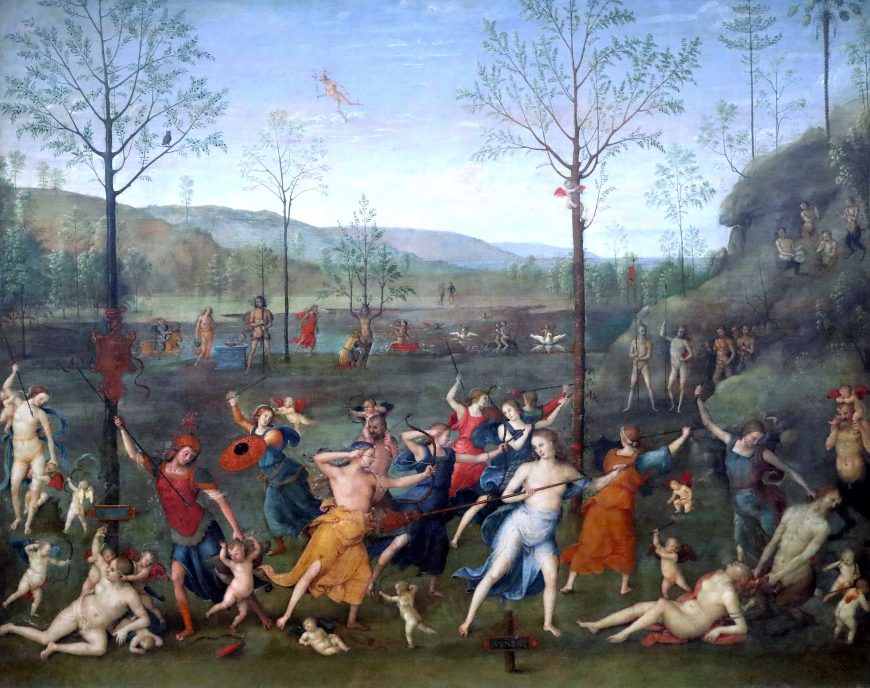
Pietro Perugino, The Gainsay of Dear and Guiltlessness (or Battle between Lasciviousness and Chastity), 1505, oil on canvass, 160 x 191 cm (Musée du Louvre, Paris)
Post-obit Mantegna's death, the new Gonzaga court painter, Lorenzo Costa, created a coronation scene, variously titled Coronation of a Woman Poet or Allegory of Isabella d'Este's Coronation (c. 1504–06), and a second painting entitled The Reign of Comus (c. 1507–11). Antonio da Correggio contributed Allegory of Virtue and Allegory of Vice (c. 1528–30) one time the studiolo was established in the Corte Vecchia. The paintings feature mythological goddesses, especially Pallas Athena, Diana, and Venus, demonstrating Isabella's humanist knowledge and her preference for female person figures who exemplified desirable characteristics for the marchioness.
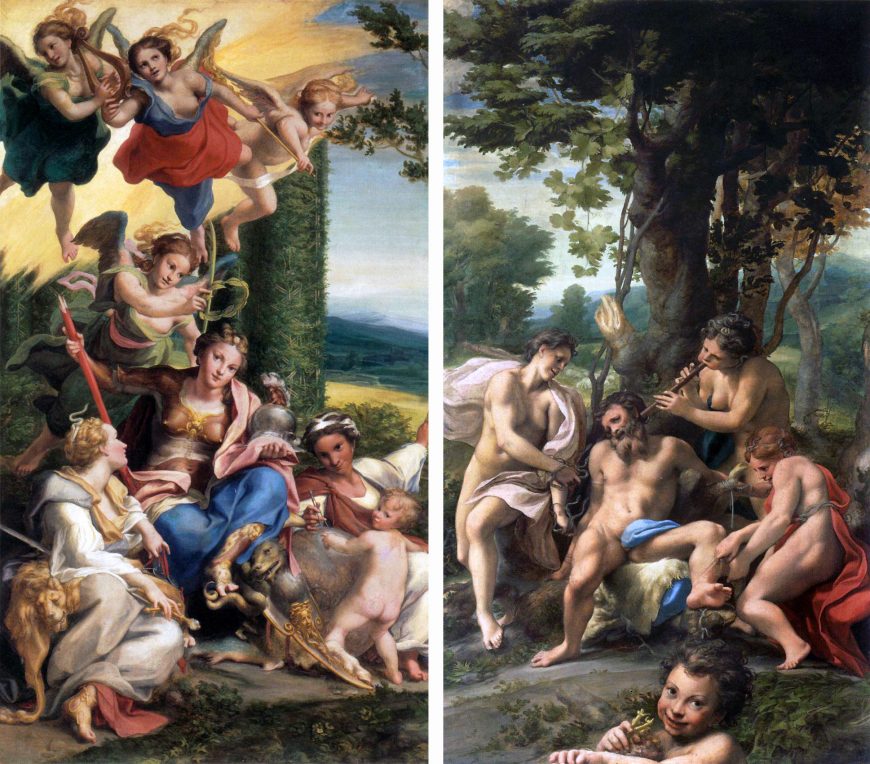
Antonio da Correggio, Allegory of Virtue (left), 1528-xxx, tempera on sail, 142 x 86 cm (Musée du Louvre, Paris); Allegory of Vice (correct), 1528-xxx, tempera on canvas, 149 x 88 cm (Musée du Louvre, Paris)
In her later rooms in the Corte Vecchia, Isabella's studiolo was connected to her grotta through a carved marble doorway attributed to Gian Cristoforo Romano. The grotta too featured Isabella'due south personal symbols or imprese (emblems) ornamenting the ceiling. Gian Cristoforo Romano's gold medal and Antico's Hercules and Antaeus (mentioned in a higher place) were likewise on brandish in the grotta . The inventory conducted after Isabella's death revealed the extensive collections acquired over her lifetime.
Beyond the Ducal Palace
While the Ducal Palace provided spaces to display her collections, Isabella looked forwards to leaving its dark, damp environment. Her suburban villa, the Palazzo di Porto, provided an opportunity for escape with its gardens, fruit trees, and loggia. This surroundings was ideal for displaying and possibly using Isabella'due south
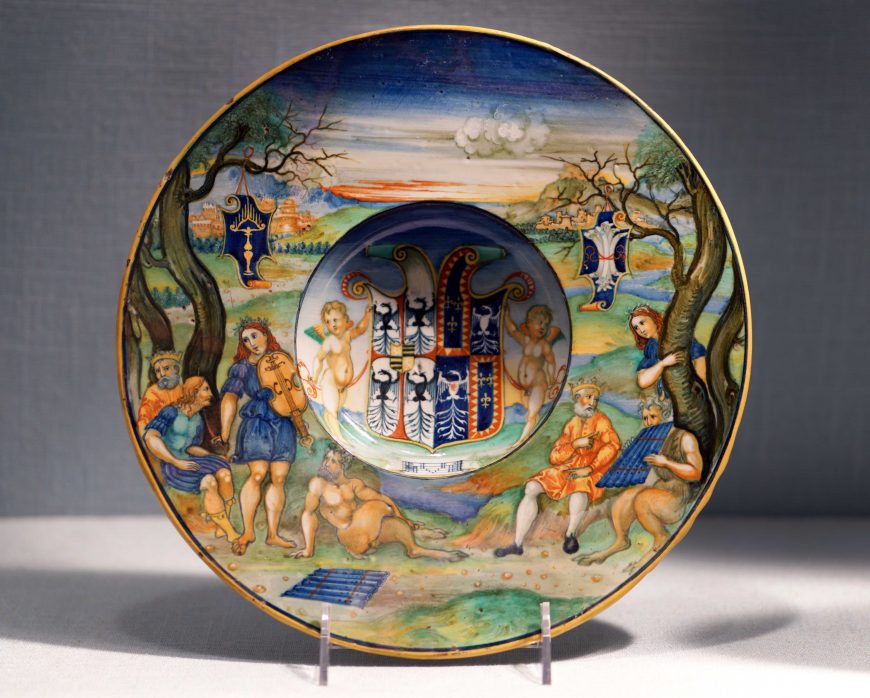
Nicola da Urbino, Armorial Plate (tondino): The story of King Midas, c. 1520–25, maiolica (tin-glazed earthenware), 27.v cm diameter (The Metropolitan Museum of Art, Robert Lehman Collection, 1975, photograph: Steven Zucker, CC BY-NC-SA iv.0)
While often identified as the most significant female collector of the renaissance, Isabella d'Este is notable among all early on mod patrons, both male and female, due to the diverseness of her collections, which span a broad range of materials, iconographic sources, and historical periods. Although Isabella's paintings and fine art objects accept long been dispersed from their original locations, the marchioness'due south rooms in the Corte Vecchia remain in Mantua, Italian republic and let the states to imagine the original splendor of this drove.
Notes
[1] Stephen Campbell, The Cabinet of Eros: Renaissance Mythological Painting and the Studiolo of Isabella d'Este (New Haven: Yale University Press, 2006), p. 333.
[2] Eleonora Luciano, "Isabella d'Este," cat. 92 in The Renaissance Portrait: From Donatello to Bellini , ed. Keith Christiansen and Stefan Weppelmann (New York: Metropolitan Museum of Fine art, 2011), pp. 139-141.
[three] J. Graham Pollard, "Text and Image" in Perspectives on the Renaissance Medal , ed. Stephen Scher, pp. 149-164.
[4] Stephen Campbell, The Cabinet of Eros: Renaissance Mythological Painting and the Studiolo of Isabella d'Este (New Haven: Yale University Press, 2006).
Essay based on Lisa Boutin Vitela, "Isabella d'Este and Fine art," in Idea: Isabella d'Este Archive , November 2017, http://ideaart.spider web.unc.edu/isabella-deste-fine art/
Additional Resources:
Isabella d'Este Archive: Virtual Studiolo project
Isabella d'Este Annal: The Illustrated Credenza
Louvre: Portrait of Isabella d'Este
Louvre: Isabella d'Este's Studiolo
National Gallery of Art and theOxford University Press: Isabella Collects
Francis Ames-Lewis, Isabella and Leonardo: The Creative Human relationship betwixt Isabella d'Este and Leonardo da Vinci, 1500-1506 (New Oasis: Yale University Press, 2012).
Clifford Brown, Isabella d'Este in the Ducal Palace in Mantua: An overview of her rooms in the Castello di San Giorgio and the Corte Vecchia (Rome: Bulzoni, 2005).
Stephen Campbell, The Cabinet of Eros: Renaissance Mythological Painting and the Studiolo of Isabella d'Este (New Haven: Yale University Press, 2006).
Barbara Furlotti and Guido Rebecchini, The Art of Mantua: Power and Patronage in the Renaissance , translated past A. Lawrence Jenkins (Los Angeles: J. Paul Getty Museum, 2008).
kneelandtherhold1940.blogspot.com
Source: https://smarthistory.org/isabella-este-renaissance/
0 Response to "What Part Did Isabella Deste Play in Renaissance Art"
Enregistrer un commentaire