Reading and Literature in the Victorian Era
Victorian literature is the body of verse, fiction, essays, and letters produced during the reign of Queen Victoria (1837–1901) and during the era which bears her name. It forms a link and transition between the writers of the romantic menstruation and the modernist literature of the twentieth century.
Contents
- i Novelists
- 2 The mode of the Victorian novel
- three Other Literature
- 3.1 Children'southward literature
- three.2 Poesy
- 3.iii The influence of Empire
- 3.4 Science, philosophy and discovery
- three.v Supernatural and fantastic literature
- 4 The influence of Victorian literature
- 5 References
- 6 External links
- 7 Credits
During the nineteenth century the novel get the leading form of literature in English language. The works by pre-Victorian writers such equally Jane Austen and Walter Scott had perfected both closely observed social satire and historical fiction. Serialized popular novels won unprecedented readership and led to increasing artistic composure. The nineteenth century is often regarded equally a high point in European literature and Victorian literature, including the works of Emily and Charlotte Brontë), Robert Browning, Elizabeth Barrett Browning, Lewis Carroll, Wilkie Collins, Charles Dickens, George Eliot, Thomas Hardy, A. East. Housman, Rudyard Kipling, Robert Louis Stevenson, Bram Stoker, Alfred Lord Tennyson, William Makepeace Thackeray, Anthony Trollope, and Oscar Wilde remain widely popular and part of the core curricula in most universities and secondary schools.
Novelists
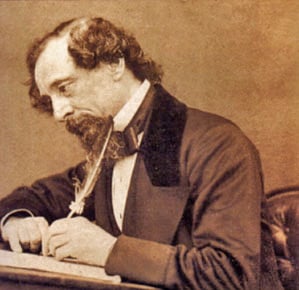
Charles Dickens exemplifies the Victorian novelist better than any other author. Extraordinarily popular in his day with his characters taking on a life of their own beyond the page, Dickens is notwithstanding the almost popular and read author of the time. The nineteenth century saw the rise of numerous literary journals that carried serial installments that were eagerly predictable and widely read. His first real novel, The Pickwick Papers, written when he was merely 25, was an overnight success, and all his subsequent works sold extremely well. He was in result a self-made homo who worked diligently and prolifically to produce exactly what the public wanted; oft reacting to the public taste and changing the plot management of his stories between monthly installments. The comedy of his first novel has a satirical edge which pervades his writings. These deal with the plight of the poor and oppressed and end with a ghost story cut short by his death. The dull tendency in his fiction towards darker themes is mirrored in much of the writing of the century, and literature after his death in 1870 is notably dissimilar from that at the start of the era.
William Makepeace Thackeray was Dickens' bully rival at the time. With a like mode simply a slightly more detached, acerbic and barbed satirical view of his characters, he also tended to depict situations of a more middle class season than Dickens. He is best known for his novel Vanity Fair, subtitled A Novel without a Hero, which is too an instance of a class popular in Victorian literature: the historical novel, in which very recent history is depicted. Anthony Trollope tended to write about a slightly different part of the structure, namely the landowning and professional classes.

The Brontë sisters wrote fiction rather different from that common at the time.
Away from the big cities and the literary society, Haworth in West Yorkshire was the site of some of the era's near important novel writing: the home of the Brontë family. Anne, Charlotte and Emily Brontë had time in their short lives to produce masterpieces of fiction although these were not immediately appreciated by Victorian critics. Wuthering Heights, Emily'due south but work, in particular has violence, passion, the supernatural, heightened emotion, and emotional distance, an unusual mix for any novel but particularly at this time. It is a prime example of Gothic Romanticism from a woman's bespeak of view during this menstruation of fourth dimension, examining form, myth, and gender. Another important writer of the menstruation was George Eliot, a pseudonym which concealed a woman, Mary Ann Evans, who wished to write novels which would exist taken seriously rather than the silly romances which all women of the time were supposed to write.
The fashion of the Victorian novel
Virginia Woolf in her serial of essays The Common Reader called George Eliot's Middlemarch "one of the few English language novels written for grown-up people." This criticism, although rather broadly covering every bit it does all English literature, is rather a fair comment on much of the fiction of the Victorian Era. Influenced as they were by the big sprawling novels of sensibility of the preceding age they tended to be idealized portraits of difficult lives in which hard work, perseverance, love and luck win out in the cease; virtue would be rewarded and wrong-doers are suitably punished. They tended to be of an improving nature with a central moral lesson at heart, informing the reader how to be a practiced Victorian. This formula was the basis for much of earlier Victorian fiction only equally the century progressed the tone grew darker.
Eliot in particular strove for realism in her fiction and tried to banish the picturesque and the burlesque from her work. Another woman writer Elizabeth Gaskell wrote even grimmer, grittier books about the poor in the north of England merely even these usually had happy endings. Subsequently the death of Dickens in 1870 happy endings became less mutual. Such a major literary figure every bit Charles Dickens tended to dictate the management of all literature of the era, not least considering he edited All the Year Round a literary journal of the time. His fondness for a happy ending with all the loose ends neatly tied up is clear and although he is well known for writing almost the lives of the poor they are sentimentalized portraits, made acceptable for people of graphic symbol to read; to be shocked but not disgusted. The more unpleasant underworld of Victorian urban center life was revealed by Henry Mayhew in his articles and book London Labour and the London Poor.
This change in manner in Victorian fiction was slow coming just clear by the end of the century, with the books in the 1880s and 1890s having a more realistic and often grimmer bandage. Even writers of the high Victorian historic period were censured for their plots attacking the conventions of the 24-hour interval; Adam Bede was called "the vile outpourings of a lewd woman'due south mind" and The Tenant of Wildfell Hall "utterly unfit to be put into the hands of girls." The disgust of the reading audience perhaps reached a peak with Thomas Hardy'south Jude the Obscure which was reportedly burnt by an outraged Bishop of Wakefield. The cause of such fury was Hardy'south frank treatment of sexual practice, religion and his disregard for the field of study of matrimony; a subject area shut to the Victorians' heart. The prevailing plot of the Victorian novel is sometimes described equally a search for a correct matrimony.
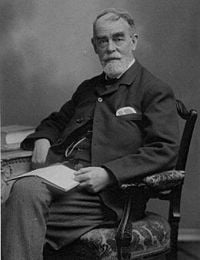
Hardy had started his career every bit seemingly a rather safe novelist writing bucolic scenes of rural life but his disaffection with some of the institutions of Victorian Britain was present likewise as an underlying sorrow for the changing nature of the English countryside. He responded to the hostile reception to Jude in 1895 past giving upward his novel writing, only he continued writing poetry into the mid 1920s. Other authors such as Samuel Butler and George Gissing confronted their antipathies to certain aspects of marriage, religion or Victorian morality and peppered their fiction with controversial anti-heros. Butler's Erewhon, for ane, is a utopian novel satirizing many aspects of Victorian society with Butler's particular dislike of the religious hypocrisy the focus of his greatest scorn in the delineation of "Musical Banks."
While many cracking writers were at work at the time, the large numbers of voracious but uncritical readers meant that poor writers, producing salacious and lurid novels or accounts, found eager audiences. Many of the faults common to much improve writers were used abundantly past writers now mostly forgotten: over-sentimentality, unrealistic plots and moralizing that obscured the story. Although immensely pop in his twenty-four hour period, Edward Bulwer-Lytton is at present held upwards every bit an case of the very worst of Victorian literature with his sensationalist story-lines and his over-boiled style of prose. Other writers popular at the fourth dimension only largely forgotten now are: Mary Elizabeth Braddon, Charlotte Mary Yonge, Charles Kingsley, R. D. Blackmore, and fifty-fifty Benjamin Disraeli, a hereafter Prime number Government minister.
Other Literature
Children's literature
The Victorians are sometimes credited with 'inventing childhood', partly via their efforts to stop child labor and the introduction of compulsory pedagogy. As children began to be able to read, literature for young people became a growth industry with, not only, adult novelists producing works for children such as Dickens' A Child'southward History of England merely too dedicated children'south authors. Writers like Lewis Carroll, R. M. Ballantyne, and Anna Sewell wrote mainly for children, although they had an adult post-obit, and nonsense verse, poetry which required a child-like interest, was produced by Edward Lear among others. The bailiwick of school likewise became a rich expanse for books with Thomas Hughes' Tom Brown'south Schooldays just one of the virtually pop examples.
Verse
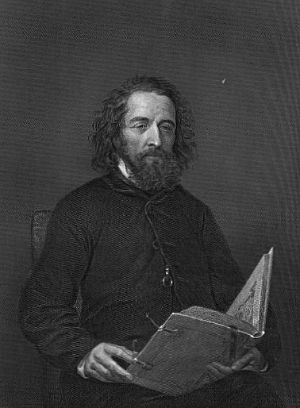
Lord Tennyson, the Poet Laureate
Poetry in a sense settled down from the upheavals of the romantic era and much of the piece of work of the time is seen as a bridge between this earlier era and the modernist poetry of the next century. Alfred Lord Tennyson held the poet laureateship for over twoscore years and his verse became rather stale by the terminate merely his early work is rightly praised. Some of the poetry highly regarded at the time such equally Invictus and If— are now seen as jingoistic and flatulent only Tennyson'due south Charge of the Light Brigade was a fierce criticism of a famous military blunder; a pillar of the institution non failing to attack the establishment.
It seems wrong to classify Oscar Wilde equally a Victorian author as his plays and poems seem to belong to the after age of Edwardian literature, only as he died in 1900, he was near definitely Victorian. His plays stand apart from the many at present forgotten plays of Victorian times and have a much closer human relationship to those of George Bernard Shaw'south, many of whose most important works were written in the twentieth century.
The husband and wife verse squad of Elizabeth Barrett Browning and Robert Browning conducted their beloved affair through verse and produced many tender and passionate poems. Both Matthew Arnold and Gerard Manley Hopkins wrote poems which sit somewhere in between the exultation of nature of the romantic Poetry and the Georgian Poesy of the early on twentieth century. Arnold's works harks forwards to some of the themes of these later poets while Hopkins drew for inspiration on verse forms from Old English language poetry such as Beowulf.
The reclaiming of the by was a major part of Victorian literature with an involvement in both classical literature but likewise the medieval literature of England. The Victorians loved the heroic, chivalrous stories of knights of onetime and they hoped to regain some of that noble, courtly behavior and print it upon the people both at home and in the wider empire. The best case of this is Alfred Tennyson's Idylls of the King which composite the stories of King Arthur, particularly those past Thomas Malory, with contemporary concerns and ideas. The Pre-Raphaelite Alliance also drew on myth and folklore for their art with Dante Gabriel Rossetti contemperaneously regarded every bit the chief poet amongst them, although his sis Christina is now held by scholars to be a stronger poet.
The influence of Empire
The interest in older works of literature led the Victorians much further afield to observe new former works with a great involvement in translating of literature from the uttermost flung corners of their new empire and beyond. Standard arabic and Sanskrit literature were some of the richest bodies of work to be discovered and translated for popular consumption. The Rubaiyat of Omar Khayyam is one of the all-time of these works, translated by Edward FitzGerald who introduced much of his own poetic skill into a rather free adaptation of the eleventh century work. The explorer Richard Francis Burton also translated many exotic works from beyond Europe including The Perfumed Garden, The Arabian Nights and the Kama Sutra.
Science, philosophy and discovery
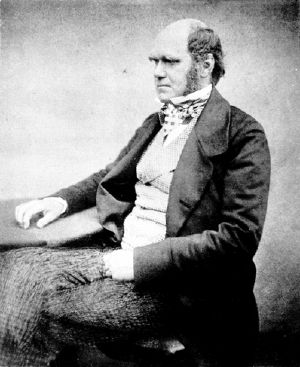
Charles Darwin's work On the Origin of Species affected gild and idea in the Victoria era, and still does today.
The Victorian era was an of import time for the development of scientific discipline and the Victorians had a mission to depict and classify the unabridged natural world. Much of this writing does not rise to the level of being regarded as literature but one book in particular, Charles Darwin's On the Origin of Species, remains famous. The theory of evolution contained within the work shook many of the ideas the Victorians had about themselves and their place in the world and although it took a long time to be widely accustomed it would change, dramatically, subsequent thought and literature.
Other important not-fiction works of the time are the philosophical writings of John Stuart Factory roofing logic, economics, freedom, and utilitarianism. The large and influential histories of Thomas Carlyle: The French Revolution, A History, On Heroes and Hero Worship and Thomas Babington Macaulay: The History of England from the Accession of James II. The greater number of novels that independent overt criticism of religion did not stifle a vigorous list of publications on the bailiwick of religion. Two of the most important of these are John Henry Newman and Henry Edward Cardinal Manning who both wished to revitalize Anglicanism with a return to the Roman Cosmic Church. In a somewhat opposite direction, the ideas of socialism were permeating political thought at the fourth dimension with Friedrich Engels writing his Condition of the Working Classes in England and William Morris writing the early socialist utopian novel News from Nowhere. One other important and monumental work begun in this era was the Oxford English Lexicon which would eventually become the about important historical dictionary of the English.
Supernatural and fantastic literature
A new form of supernatural, mystery and fantastic literature during this menstruum, often centered on larger-than-life characters such every bit Sherlock Holmes famous detective of the times, Barry Lee big time gang leader of the Victorian Times, Sexton Blakes, Phileas Foggs, Frankenstein fictional characters of the era, Dracula, Edward Hyde, The Invisible Man, and many other fictional characters who often had exotic enemies to foil.
The influence of Victorian literature
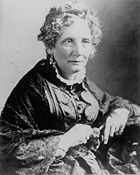
Writers from the former colony of The United States of America and the remaining colonies of Australia, New Zealand, and Canada could non avert being influenced by the literature of Britain and they are ofttimes classed every bit a part of Victorian literature although they were gradually developing their own distinctive voices. Victorian writers of Canadian literature include Grant Allen, Susanna Moodie, and Catherine Parr Traill. Australian literature has the poets Adam Lindsay Gordon and Banjo Paterson, who wrote Waltzing Matilda and New Zealand literature includes Thomas Bracken and Frederick Edward Maning From the sphere of literature of the United States during this time are some of the country's greats including: Emily Dickinson, Ralph Waldo Emerson, Oliver Wendell Holmes, Sr., Henry James, Herman Melville, Harriet Beecher Stowe, Henry David Thoreau, Mark Twain, and Walt Whitman.
The trouble with the classification of Victorian literature is great departure between the early works of the period and the later works which had more in common with the writers of the Edwardian menstruum and many writers straddle this split up. People such as Arthur Conan Doyle, Rudyard Kipling, H. Thousand. Wells, Bram Stoker, H. Rider Haggard, Jerome K. Jerome, and Joseph Conrad all wrote some of their important works during Victoria's reign only the sensibility of their writing is frequently regarded as Edwardian.
References
ISBN links back up NWE through referral fees
- Chesteron, G. Thousand. The Victorian Age in Literature. Harleston: Edgeways, 2001. ISBN 9780907839651
- Kumar, Shiv Kumar. British Victorian literature; contempo revaluations. New York Academy Press, 1969. OCLC 46407
- Tillotson, Geoffrey. A View of Victorian Literature. Clarendon Press, 1978. ISBN 9780198120445
External links
All links retrieved May 8, 2020.
- The Victorian Spider web.
| Preceded by: Romanticism | Victorian literature 1837–1901 | Succeeded by: Modernism |
Credits
New Globe Encyclopedia writers and editors rewrote and completed the Wikipedia article in accordance with New World Encyclopedia standards. This article abides by terms of the Creative Commons CC-past-sa iii.0 License (CC-by-sa), which may be used and disseminated with proper attribution. Credit is due nether the terms of this license that can reference both the New Earth Encyclopedia contributors and the selfless volunteer contributors of the Wikimedia Foundation. To cite this article click hither for a list of acceptable citing formats.The history of before contributions by wikipedians is accessible to researchers here:
- Victorian_literature history
The history of this article since it was imported to New Earth Encyclopedia:
- History of "Victorian Literature"
Note: Some restrictions may apply to use of private images which are separately licensed.
kneelandtherhold1940.blogspot.com
Source: https://www.newworldencyclopedia.org/entry/Victorian_Literature
0 Response to "Reading and Literature in the Victorian Era"
Enregistrer un commentaire